


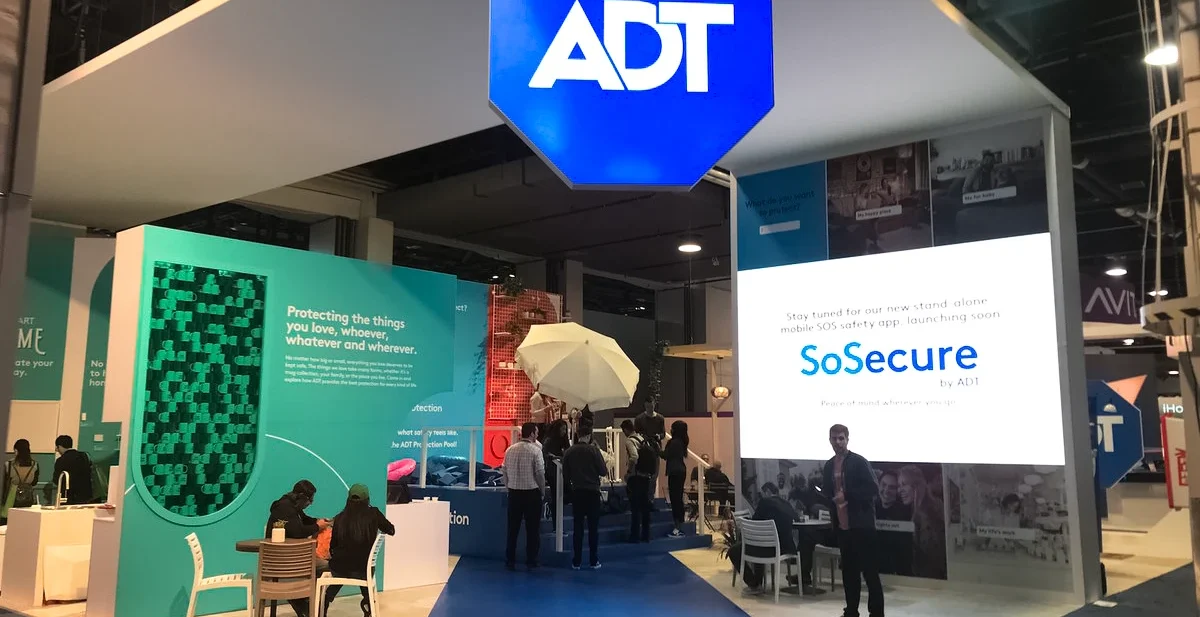
A show gives you a six-foot table, two chairs and a pleated drape in the same color as everyone else’s. The table sits at the front of the booth at the height where a visitor’s eyes land when they stop walking, and it is the surface people stand at while they talk to you. It is the piece of the booth most often left generic.
This guide covers how to size a trade show table cover for the table a show actually provides, the three fit styles and what each one looks like on the floor, where artwork belongs so it is not hidden by chairs and literature, and what a printer needs from you before anything goes on press. Color Reflections prints custom table covers as part of its trade show displays and graphics work, and every indoor and outdoor package on its trade show packages list includes one.
Key takeaways
- A six-foot table is usually 72 inches long and an eight-foot table 96 inches, both about 30 inches wide and 30 inches high. Measure the one you are given, because show tables vary.
- There are three fit styles. A throw drapes loosely over the table, a fitted cover is sewn to the table’s dimensions, and a stretch cover is cut slightly under them so the knit pulls flat.
- A cover sized for one table length does not work on the other. A six-foot cover leaves an eight-foot table exposed at both ends; an eight-foot cover pools on the floor of a six-foot table.
- The front panel is the part that gets read. Keep the name and logo in the upper two-thirds, clear of the bottom edge where chairs, bags and legs sit.
- Every Color Reflections trade show package, indoor and outdoor, includes a custom printed table cover.
The table cover is the graphic people read standing still
A backdrop and a hanging sign are read from the aisle, at twenty or thirty feet, by someone still walking. The table cover is read from three feet by someone who has already stopped. That changes what belongs on it. The backdrop carries the one idea you want shouted down the aisle. The cover carries the name of the company, said clearly, at the moment a visitor is deciding whether to open a conversation.
The table is also where photographs of the booth get taken, because it is where people stand, sign up and shake hands. A pleated drape from the show kit puts nothing in those pictures.
Measure the table the show is actually giving you
Covers are cut to a table, not to a guess. Most United States exhibit halls supply folding banquet tables in two lengths: six-foot, about 72 inches long, and eight-foot, about 96 inches. Both are usually about 30 inches wide and stand about 30 inches high, though some models run 29 inches high or 36 inches wide. Counter-height tables, at around 42 inches, are a different item and need a cover cut for that height.
The table size is normally stated in the exhibitor kit or on the furniture order form for the show. Read it before you order the graphic, and if the booth is in a venue you have not exhibited in before, measure the table on move-in day the first time and keep the number. The two failures are equally visible from the aisle: a cover that is short leaves bare table legs and a gap of drape color at each end, and a cover that is long sits in a fold on the carpet and gets stepped on.
Three fit styles, and where each one belongs
A throw is a single flat piece of printed fabric laid over the table so it drapes on all sides. It is the most forgiving of the three: the same throw works on tables that differ by an inch or two, and it packs small. The trade-off is that the fabric moves. Corners hang in soft folds, and anything printed near an edge can end up distorted or tucked out of sight.
A fitted cover is sewn to the table’s length, width and height, with stitched corners that square off the front panel. The artwork stays where you put it, and the front reads as a flat printed surface rather than a cloth. Because it is built to one table, it fits only that table.
A stretch cover is a knit panel cut slightly under the table’s dimensions so the fabric is under tension when it is on. It pulls flat and stays flat for three days of a show without the ripples a woven cover develops. Like a fitted cover, it is sized to one table.
Each of the three also comes open-backed or closed. An open back leaves the exhibitor’s side of the table open so you can push cases, water and coats underneath and still reach them. A closed back encloses all four sides, which is what you want when the booth is an island and people walk round all of it.
The front panel is the part that gets read
On a six-foot table the front panel is roughly 72 inches wide and 30 inches tall, and on an eight-foot table roughly 96 by 30. That is a wide, shallow shape, which is why type set in a square block never looks right on it.
Three placement rules hold up on a show floor. Keep the company name and logo in the upper two-thirds of the panel, because the bottom few inches are blocked by chairs, bags and the legs of whoever is standing at the table. Keep type away from the corners, where a fitted cover turns the fabric through ninety degrees and a throw folds it. And put something on the short ends as well, even if it is only the logo, because half of the people who see the booth approach it from one side of the aisle rather than head-on.
Keep the wording short. The name, and one line saying what you make or do, is usually everything the panel can carry at a size people can read from standing distance. Detail belongs on the retractable banner behind the table or on the literature lying on it.
Fabric, printing and what the fold does
Printed table covers are polyester. Color Reflections prints fabric by dye sublimation, a process it introduced to its area along with Lambda digital photo prints and oversize high-resolution scanning. In dye sublimation the dye turns to gas and bonds into the polyester fiber rather than sitting on top of it as a layer of ink, so the color does not crack along a crease when the cover is folded into a case for the next show.
Folding still leaves wrinkles. Knit stretch fabric recovers from them fastest because tension pulls the panel flat once it is on the table; a woven throw usually needs to be hung or steamed the night before. Plan for that in the move-in schedule rather than at eight in the morning on day one.
Fabric is what the rest of the soft side of a booth is printed on too: the step and repeat backdrop that stands behind the table, and the silicone edge graphics stretched into frames beside it. It is worth ordering them from one set of files and one supplier rather than three.
The cover is rarely bought on its own
A table cover alone is a table with your name on it. What an exhibitor usually needs is the cover plus the thing behind it and the thing beside it, which is how the Color Reflections trade show packages are built. Each one includes a custom printed table cover and pairs it with banners, a fabric backdrop, floor graphics, a tent or flags depending on whether you are exhibiting indoors or outdoors.
Trade show packages
Every package starts with a printed table cover
Starting price of each indoor and outdoor package
Indoor: 6′ cover, 60″ banner
Indoor: 8′ cover, banner, backdrop
Indoor: adds floor graphics, 10×10
Outdoor: tent, flag, 6′ cover
Outdoor: deluxe tent, 8′ cover
Outdoor: tent walls, 2 flags
Source: Color Reflections trade show package starting prices, listed November 2026. Add-ons and custom sizes are quoted separately.
The indoor packages run from a six-foot cover with a 60-inch retractable banner, through an eight-foot cover with a banner and an eight-foot pillowcase fabric backdrop, to an eight-foot cover with two banners, printed floor graphics and a 10 by 10 foot backdrop with hardware. The outdoor packages swap the backdrop for a printed 10 by 10 pop-up tent and add flags, up to a tent with two sidewalls and a back wall, a banner stand, a six-foot cover and two 12-foot flags.
What to send the printer
Four things make a table cover straightforward to produce. The exact table measurements, in inches, taken from the table rather than the show’s description of it. The fit style you want, and whether the back is open or closed. Logos as vector art, with the fonts outlined, so the name stays sharp across 96 inches. And brand colors named as Pantone references rather than described, because a fabric press matches to a number, not to a word.
Photographs on a cover need resolution to match their printed size. A picture that was sized for a web page is going to be forty times larger on the front panel. Large files go through the file upload page rather than email, which has size limits that most booth artwork exceeds.
Getting it to the show
Color Reflections ships to all 50 states and to the Caribbean territories including Puerto Rico and the US Virgin Islands, and handles shipping, distribution and installation for booth graphics, so a cover can be sent to the show’s advance warehouse with the rest of the exhibit rather than carried. When the date has already moved, its EXPress Service offers next-day turnaround; rush charges apply.
Printing runs from three locations: Hollywood, Florida; Atlanta, Georgia; and Philadelphia, Pennsylvania. If the show is near one of them, the finished cover can be collected rather than shipped.
Frequently asked questions
What size table cover do I need for a six-foot table?
One cut for a table about 72 inches long, 30 inches wide and 30 inches high. Confirm the height as well as the length, because a cover sized for a 30-inch table hangs short on a counter-height one.
Will an eight-foot cover work on a six-foot table?
Not well. It will hang past both ends and fold onto the floor. Fitted and stretch covers are built to one table size; only a throw tolerates a small difference.
What is the difference between a throw, a fitted cover and a stretch cover?
A throw drapes loosely and packs small. A fitted cover is sewn to the table’s dimensions and keeps the artwork square. A stretch cover is cut slightly under the table so the knit holds itself flat.
Where should the logo sit on the front panel?
In the upper two-thirds, away from the corners and away from the bottom edge, which is blocked by chairs and by the people standing at the table.
Do the trade show packages include a table cover?
Yes. All six indoor and outdoor packages include a custom printed table cover, in either a six-foot or an eight-foot size depending on the package.
Can a table cover be printed in a rush?
EXPress Service offers next-day turnaround, with rush charges. Say the in-hands date and the show date when you ask for the quote, not after the order is placed.
What else is usually ordered with it?
A retractable banner or a fabric backdrop behind the table, and floor graphics in front of it. The guide to trade show displays covers how those pieces fit together.
Order a printed table cover
Start with the table: its length, width and height, and whether you want a throw, a fitted cover or a stretch cover. With those four facts and a vector logo, a cover can be quoted and produced without a second round of questions.
Take it to trade show displays and graphics for a cover on its own, or to the trade show packages if you also need what goes behind and beside it.