


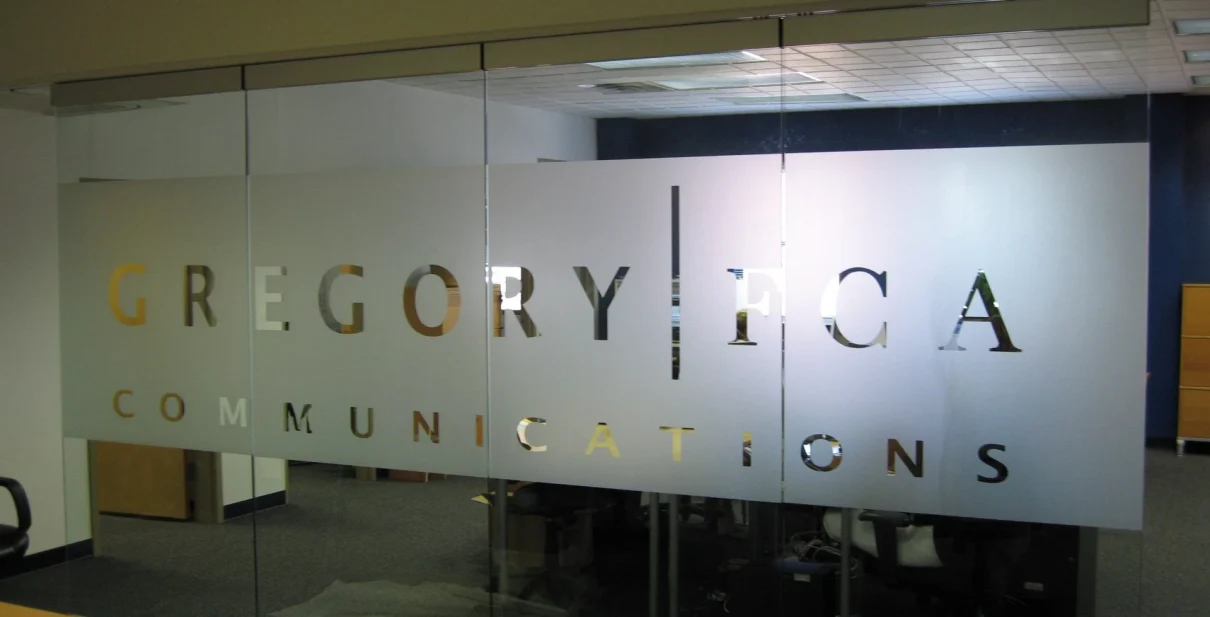
Glass offices solved one problem and created another. Open sightlines made floorplates feel bigger and brighter, and then every conference room became a fishbowl. Privacy film is the usual fix: a printed or frosted film applied to the glass that blocks sightlines without taking the light away or putting a wall back.
It looks like a simple purchase. It is not. The same roll of film can read as elegant or as a patch job depending on where it sits on the glass, which side of the pane it goes on, and how the artwork was built. This guide covers what office window privacy film is, how to decide the coverage and the mounting surface, and what a printer needs from you before anything gets cut.
Key takeaways
- Privacy film blocks sightlines while passing daylight, which is why it replaces blinds and drywall in glass-walled offices.
- Coverage is the real decision: a full frosted panel, a band at seated eye level, or a logo knocked out of frost.
- Pick the viewing side before artwork starts. It decides which face of the glass the film goes on and whether the file has to be mirrored.
- Film changes what people can see through the glass. It does not change how the glass is rated to break.
- Measure the visible glass, not the opening, and ask for a physical sample before you approve an opacity.
What office window privacy film actually is
Privacy film is an adhesive film applied to a glass surface that obscures what is behind it while still letting light through. At one end it is a plain frosted or etched-look film with no print on it. At the other it is a full-color printed graphic with your brand on it. Most office work lands somewhere in between.
Color Reflections produces these as part of its custom glass graphics and privacy treatments work, and describes the range plainly: privacy graphics can be custom designed with your logo, messaging or other brand motif, and the shop can also do a full frosted film look or window-size opaque designs for closed-door meetings.
That last phrase is the whole brief for most conference rooms. You want the meeting unreadable from the corridor and you want the room to still feel like it has windows.
Frosted film, clings and decals are not the same product
These three get used interchangeably in briefs and they behave differently once they are on the glass. The difference that matters most is permanence.
Color Reflections notes that window clings tend to be less permanent, so installation should be carefully considered during the design process. A cling is the right call for a seasonal retail message. It is the wrong call for a conference room you expect to look the same in three years.
| Treatment | Best for | Trade-off |
|---|---|---|
| Frosted privacy film | Conference rooms and private offices that need permanent visual separation | Changing it later means removing and reapplying film |
| Printed privacy film | Privacy plus branding on the same pane | Artwork and proofing add time before install |
| Window cling | Campaigns and seasonal messages you plan to swap | Less permanent, so placement needs care up front |
| Vinyl decal | Logos, hours, room names, cut shapes | Gives you a graphic, not coverage |
If you are weighing the last two against each other, the difference between a window cling and a window decal is worth reading before you brief anything, and there is a separate guide to designing decals and clings that covers the artwork side.
Coverage: the decision that changes how the room feels
Three patterns cover almost every office job.
Full-panel frost. The entire pane is frosted. The room is private from floor to ceiling and still daylit. This is the default for HR offices, clinical rooms and any space where a whiteboard is in the sightline.
A band at seated eye level. A horizontal strip of frost across the middle of the glass. People standing in the corridor cannot read the room; people sitting inside still get a view out above and below the band. This is the most common office treatment because it buys privacy without closing the room in. It is also the pattern that keeps people from walking into glass they did not register.
A knockout. The pane is frosted and your logo or wordmark is cut out of the frost, so the letters stay clear glass and read against whatever is behind them. It is the same reverse-cut logic used in wall graphics, applied to glass. Done well it is the cheapest branded moment in a fit-out.
You can combine them. A frosted band with the company mark knocked out of it is a single film job that handles privacy, branding and the walk-into-glass problem at once.
First surface or second surface
Every pane has two faces, and the film goes on one of them. Which one is a real decision, not a detail to leave to the installer.
Start by fixing the viewing side: who is the graphic for, the person in the corridor or the person in the room? That answer sets the face the film goes on, and it determines whether the print file has to be mirrored. Get it wrong on a wordmark and the logo reads backwards through the glass.
The second consideration is wear. The face that takes hands, carts, cleaning trolleys and vacuum heads is the face that scuffs the film. Where a pane has a protected side and an exposed side, the protected side usually wins on longevity. Color Reflections can install on either the interior or exterior of a window, so the choice is yours to make rather than a constraint to work around.
Privacy film is not safety glazing
These two get confused and the confusion is expensive. Safety glazing is a property of the glass itself: tempered or laminated panes that are rated for how they break in a hazardous location, such as a door or the panel beside it. Applied film changes what people can see through a pane. It does not change the pane’s break rating or make an unrated pane compliant. If your project involves doors, sidelites or full-height glass, confirm the glazing itself against your local building code, and treat film as a visibility and privacy layer on top of that.
Materials, and why the film stock matters
Film is not a commodity. The stock decides how the frost reads, how it handles cleaning, and whether it yellows.
Color Reflections prints its corporate and retail window graphics on LINTEC window films, and states why: in an industry where many window films contain PVC, LINTEC makes PET window films that are non-toxic, UV-blocking and scratch-resistant. The shop lists the material options as matte overlaminate window graphics with a non-glossy, satin finish; eco-friendly films made from no less than 80% recycled PET material; and both permanent and removable adhesives. The films are produced in clean facilities, so they are free of dust and other particulates.
Two of those details drive specification decisions. The matte, non-glossy satin finish is what stops a frosted panel from throwing glare back at a room full of screens. And the permanent-versus-removable adhesive choice should follow your lease and your rebrand cycle, not the price difference. A tenant two years into a five-year term should be asking for removable.
Color Reflections uses these films for offices, hospitals, hotels, schools and retail locations. The healthcare and hospitality end of that list has its own constraints, covered in the guide to window graphics for healthcare and hospitality facilities.
Where privacy film sits in a wider signage package
Glass treatments rarely arrive alone. A floor of offices getting privacy film usually needs room identification at the same time, and room identification has rules. Permanent rooms and spaces need tactile characters and Braille, which is a separate product from film and belongs with ADA and tactile signage.
The same visit is also the moment to settle wayfinding and directional signage, because the frosted band you just put on a glass corridor wall may have removed the sightline people were navigating by. Treated together, film, room signs and wayfinding read as one environmental graphics program rather than three separate purchases that do not match.
How to brief and order office window privacy film
Work through these in order and the job goes cleanly.
- Measure the visible glass, not the opening. Frames, gaskets and channels eat into the pane. Film is cut to what you can actually see.
- Fix the viewing side. Corridor or room. Write it on the drawing.
- Choose the coverage pattern. Full panel, band, knockout, or a combination.
- Ask for a physical sample. A render on a screen will not tell you how opaque a frost reads in your light. Hold the sample up to your own glass.
- Decide permanent or removable. Match this to the lease, not the budget line.
- Send print-ready artwork. Vector logos, outlined type, and the mirroring already resolved for the chosen surface.
- Book the install. Glass needs to be clean and the area clear; film goes on best before furniture comes back.
Color Reflections prints entirely in-house and both ships and installs, and the shop guarantees installation, taking precise measurements and working bubbles out of the film. That matters more on glass than on almost any other substrate, because a trapped bubble on a backlit pane is visible from across the floor.
Getting a quote
Color Reflections is a partnership of three individually owned and operated locations, in Atlanta, Georgia; Hollywood, Florida; and Philadelphia, Pennsylvania, serving work nationwide. A project consultation is free. You send the details of what you want to create, the team routes you to the location best placed to handle it, and you hear back within 24 hours about any further information needed before a quote is put together.
Have your pane sizes, your viewing side and your coverage pattern ready when you make contact. Those three answers are what turn a general enquiry into a real number. Start on the glass graphics and privacy film page, or find your nearest shop on the locations page.
Frequently asked questions
Can you see through office privacy film at night?
It depends on the light balance, not the film. Any obscuring film works by diffusing light, and when a room is brightly lit and the far side is dark, more of the room’s shape carries through. Frosted film still blocks detail. If a space needs to be fully private after dark, pair the film with a second treatment such as shades.
Will privacy film stop people walking into the glass?
A frosted band at eye level is the standard way to make a large clear pane register as a surface, and Color Reflections lists exactly that among the benefits of glass graphics: markers make the glass more visible so people do not accidentally walk into it. Decorative patterns and branded bands do the same job as a plain strip.
Can privacy film be removed without damaging the glass?
Specify a removable adhesive at order time and removal is straightforward. Color Reflections offers both permanent and removable adhesives on its LINTEC films, so this is a choice you make before printing rather than a problem you solve later.
Does privacy film block UV?
The LINTEC PET films Color Reflections prints on are UV-blocking, which also helps the graphic itself hold its color. Ask for the specific stock being quoted if UV performance is a requirement rather than a bonus.
Can we put our logo on frosted glass?
Yes, and there are two ways to do it. Print the logo onto the film, or knock it out of the frost so the letters stay clear glass. The knockout tends to look more built-in and reads well against a lit interior.
Is privacy film only for offices?
No. Color Reflections uses these films for offices, hospitals, hotels, schools and retail locations. The product is the same; the coverage pattern and the material choice change with the setting and the cleaning regime.
What artwork do you need from us?
Vector artwork with type outlined, the pane dimensions taken from the visible glass, and a note stating the viewing side so the file can be mirrored correctly if the film is going on the far face.