


Museums and galleries buy print on terms almost no other buyer does. The opening date does not move. The graphics have to hold up to months of public traffic and gallery lighting. Every panel has to read from across the room and again at arm’s length, where a visitor stands to read the label. And the content is often an artifact or an artwork that cannot be reprinted, rescanned, or risked.
This guide covers what museum exhibit graphics are made of, how murals and panels are mounted, where accessibility and wayfinding fit, and what a printer needs settled before anything goes on press. Color Reflections produces this work as part of its experiential and environmental graphics service, and the specifics below come from its own exhibit projects in Philadelphia and Pittsburgh.
Key takeaways
- An exhibit graphics package is rarely one product. The Electrified exhibit at Drexel University took murals, wall graphics, wall wraps, fabric banners, didactic panels, window graphics and custom-sewn display T-shirts.
- Wall-scale murals and individual rigid panels are two different builds: pressure-sensitive film with an overlaminate for the first, direct printing onto rigid board for the second.
- Mounting is a design decision, not an afterthought. Z-clips and spacers hold a panel off the wall and let it be removed intact at the end of the run.
- Label copy, tactile signage and wayfinding belong in the same package as the murals, so type, color and contrast match across the floor.
- A site survey and test prints before production are what keep a dark, high-detail exhibit from going wrong at full scale.
What counts as museum exhibit graphics
The phrase covers everything printed that is not the object on display. In practice a single exhibit mixes formats. For Electrified: 50 Years of Electric Factory, a Drexel University exhibit of memorabilia from the Philadelphia music venue, Color Reflections printed and installed the whole graphics package: large murals, wall graphics and custom wall wraps, fabric banners, didactic panels, window graphics, and custom-sewn giant display T-shirts.
Other exhibits need fewer formats, but need them at scale. The Carnegie Museum of Natural History in Pittsburgh came to Color Reflections for backdrops for its Dinosaurs in Their Time exhibit — grand format graphics that accent the large-scale dinosaurs on display. The National Museum of American Jewish History in Philadelphia needed one thing done well: a large exterior banner promoting its Bill Graham and the Rock & Roll Revolution special exhibition, printed and installed.
Promotion counts too. The banner that tells the street an exhibit exists, the window graphics at the entrance, and the panels inside the gallery are usually printed together, from the same files, so the type and color match from sidewalk to last wall.
Exhibit graphics, by the spec
The materials and sizes this work is built on
Film, board and scan sizes from the Microsculpture exhibit at Drexel University and the scanning service that supports exhibit work.
IJ180Cv3
the 3M Controltac film the Microsculpture lenticular murals were printed on, finished with 3M Scotchcal Matte Overlaminate 8520
6 mm
black Sintra PVC board the individual Microsculpture panels were direct printed onto, with a flood-white background behind the image
4 × 6 ft
largest original captured in a single scanning pass when an exhibit needs an artwork or document reproduced at size
10 ft+
the size a finished high-resolution scan can be printed back at, from the original size upward
Source: Color Reflections project write-up for the Microsculpture exhibit and its high-resolution scanning service page.
The two builds behind a gallery wall
Almost every exhibit graphic is one of two things, and they are not interchangeable.
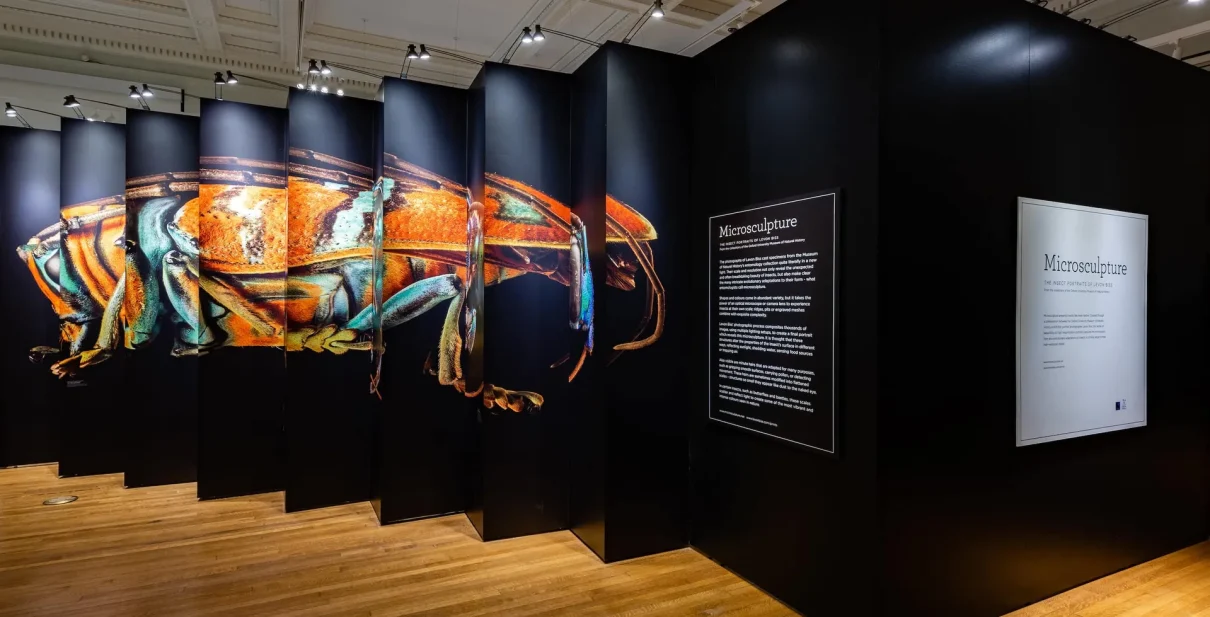
A wall-scale mural is printed on pressure-sensitive film and applied to the wall itself. The Microsculpture lenticular murals were printed onto 3M Controltac IJ180Cv3 film on an HP Latex 3600 press, then finished with 3M Scotchcal Matte Overlaminate 8520. The overlaminate is the part worth noticing: a matte finish kills the reflection from gallery spotlights, and it takes the hand contact that a reachable wall gets over a long run.
A rigid panel is printed directly onto board. For the same exhibit, the individual insect panels were direct printed with an EFI Vutek H5 flatbed onto 6 mm black Sintra PVC board, with a flood-white background laid down first so the image sat on white rather than on black. The panels were then machine-cut on a Zünd cutter and welded to shape.
Choose between them by what happens at the end of the exhibit. Film comes off the wall and is gone. A panel can be taken down whole, stored, and shipped to the next venue. Travelling exhibits lean rigid for that reason alone.
How panels get on the wall
Mounting decides how an exhibit looks and how it comes down. The Microsculpture panels were finished with z-clips and spacers added to the back, which hangs each panel a measured distance off the wall and leaves no visible fixing on the face. The shadow line that gap creates is why a flat printed panel reads as an object rather than a poster.
Anything further than that is fabrication work: dimensional signs, non-standard graphics mounting and specialized hanging hardware are part of Color Reflections’ custom fabrication service, alongside the hanging of banners in tall spaces. If your exhibit design has a shape that no stock frame fits, that is the conversation to have early, because the hardware often sets the panel’s size and bleed.
Didactic panels, labels and the accessibility layer
Interpretive copy is a printing problem as much as a curatorial one. Didactic panels were a line item on the Electrified package, and they live under the same lighting as the murals while carrying type at reading size.
Permanent room and feature identification also has to be accessible. Color Reflections’ ADA and tactile signage covers braille, raised text, and symbols and graphics. Their own guidance is blunt about the baseline: ADA signs are required at every doorway for most businesses, and Grade II braille belongs on directional signage. Exhibit labels and ADA signage are different categories, but they are read by the same visitor in the same hour, so print them from the same type and color specification.
Wayfinding is part of the exhibit
A gallery floor is a navigation problem: entrance, route, exits, restrooms, and the order the exhibit is meant to be read in. Color Reflections treats wayfinding and directional signage as a system rather than a set of signs, printed and installed to match the space. If it is not clear which of the two you need, the difference between wayfinding and directional signage is worth five minutes before you brief anyone.
When the artifact is the content
Plenty of exhibits need an original reproduced rather than a design printed: a painting, a photograph, a hand-drawn map, an architectural sheet. Color Reflections runs high-resolution scanning from its Hollywood, Florida location and names museum displays as one of the uses. Originals up to 4 by 6 feet are captured in a single pass; larger pieces are scanned in multiple passes and stitched. A finished scan can be printed back at anything from the original size up to 10 feet or more, and originals can be shipped in by FedEx or UPS and are repackaged and returned.
Decide the largest print you will ever want from the piece before the scan is taken. The guide to large format scanning covers what that choice changes.
The site survey comes before the print
Before the Microsculpture graphics were produced, the Philadelphia team ran a detailed site survey and in-house testing to refine the file and print settings. On a high-detail exhibit that step is the whole job. The insect photographs carried pigmented scales, velvet-like surface textures and iridescent color against a jet-black background, and settings that look right on a proof at desk size do not automatically hold at wall size.
Ask for a test print at final size on the final material, viewed under the gallery’s own lighting if that can be arranged. It is the cheapest hour in the project. The work on both Drexel exhibits was recognized in Big Picture magazine’s Best of Wide Format Awards, in the fifth annual awards for Microsculpture and the sixth annual for Electrified.
What to settle before you send files
- Final wall dimensions, measured on site, not taken from the architectural drawing.
- Which graphics are film on the wall and which are rigid panels, and whether any of them travel after this venue.
- Mounting method for every panel, because it changes the cut size.
- Finish: matte where spotlights hit, and anywhere a visitor can reach the surface.
- Install and de-install dates, and who is allowed in the gallery on each.
- Whether any artwork or document still needs scanning, and the largest size it will be printed at.
Large files go through the file upload page rather than email. If the design is still open, a project consultation is the place to work the mounting and material questions out loud.
Frequently asked questions
What is a didactic panel?
The interpretive panel that explains an object or a section of an exhibit, as distinct from a short object label. Didactic panels were part of the Electrified package at Drexel University.
Should exhibit graphics be film or rigid board?
Film for wall-scale murals applied directly to the wall. Rigid board for individual panels, especially if they need to come down intact, be stored, or travel to another venue.
How are rigid exhibit panels hung?
On the Microsculpture exhibit, with z-clips and spacers fixed to the back of each panel, which holds it off the wall with no visible fastener on the face. Non-standard shapes and hanging hardware are handled as custom fabrication.
Why a matte overlaminate?
It reduces reflection under gallery lighting and protects the print surface. The Microsculpture murals were finished with 3M Scotchcal Matte Overlaminate 8520.
Can an original painting or map be reproduced for an exhibit?
Yes. High-resolution scanning takes originals up to 4 by 6 feet in one pass, stitches larger pieces from multiple passes, and prints back from original size up to 10 feet or more.
Does Color Reflections install, or only print?
Both, on this kind of work. The Electrified graphics at Drexel and the banner at the National Museum of American Jewish History were printed and installed.
Which exhibits has Color Reflections worked on?
Microsculpture: The Insect Portraits of Levon Biss at the Academy of Natural Sciences of Drexel University, Electrified: 50 Years of Electric Factory at Drexel University, backdrops for Dinosaurs in Their Time at the Carnegie Museum of Natural History in Pittsburgh, and the special exhibition banner at the National Museum of American Jewish History in Philadelphia.
Plan an exhibit graphics package
Start from the install date and work backwards through site survey, test print, production and delivery. That order is what keeps the opening from being the first time anyone sees the graphics at full size.
The experiential and environmental graphics service is the right entry point for a whole-gallery package, and the Microsculpture project write-up shows the level of detail the process is built for. For exhibits in and around Philadelphia, the Philadelphia shop is the team that produced both Drexel exhibits.